AI Advancement is About Memory Now
Large language models already read, write, and reason at a level that would have seemed impossible even a decade ago. The next gains depend less on making models smarter and more on how they store, compress, and find information. Memory is the bottleneck, and it shows up at every level, from the software that chops documents into pieces to the physics of moving bits across a chip.
What Chunking Throws Away
A language model can only read so much text at once. For anything larger, such as a company’s document archive, systems use retrieval (e.g., RAG). They split documents into chunks, convert each chunk into a vector of numbers, and fetch the chunks whose vectors sit closest to the user’s question.
Chunking fractures meaning. Consider a chunk that reads, “The company’s revenue grew 3% over the previous quarter.” Pulled out on its own, the chunk no longer says which company or which quarter. The pronoun, the date, and the section heading all live somewhere else. A search for that company’s results can miss the chunk entirely, and a search that does find it hands the model a sentence with no anchor.
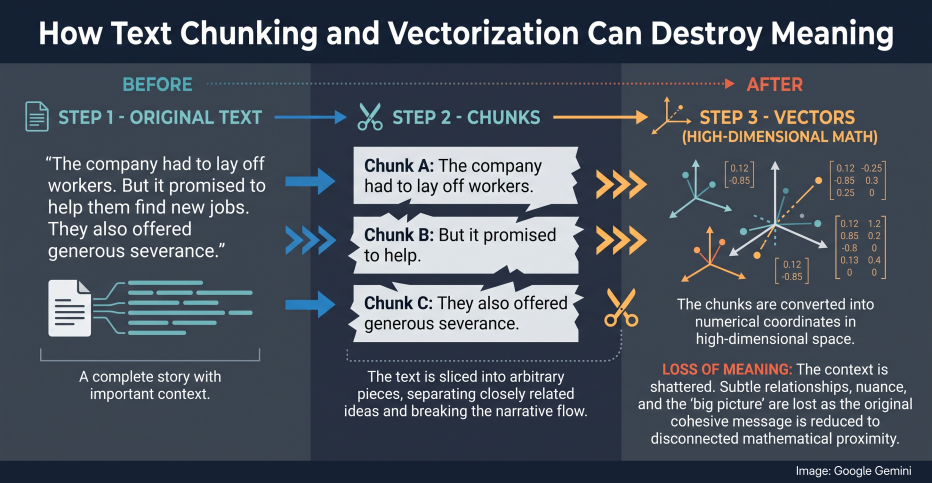
One practical fix is to attach a short description of the surrounding document to every chunk before indexing it. Anthropic published results in 2024 showing that this approach, which it calls contextual retrieval, cut failed retrievals roughly in half, and by about two-thirds when combined with a reranking step. The downside is that the technique consumes precious extra processing at indexing time, but it shows just how much was lost before.
Flat Records and Knowledge Graphs
Some information keeps its meaning when stored flat. Product manuals, FAQ entries, and meeting notes each answer questions on their own, and a list of independent records serves them perfectly.
Other information carries crucial meaning in connections. Who reports to whom, which drug interacts with which, how one legal clause modifies another: these questions require the tracing of links across many documents. A knowledge graph stores entities as nodes and relationships as edges, so a system can walk from one fact to the next. Microsoft’s GraphRAG work in 2024 showed that graph structure helps most with broad questions about a whole collection, such as “what themes recur across these reports?”, where nearest-neighbor chunk lookup has no single passage to find. Graphs cost more to build and maintain, so the sensible rule is to match the structure to the data. Use flat storage where records stand alone and a graph where relationships carry the answer.
A Hierarchy Borrowed From Computers and Brains
Computers manage memory in tiers: registers, cache, RAM, solid-state storage, and disk. Each tier is larger and slower than the one above it. Operating systems hide the tiers behind virtual memory, moving data between RAM and disk in pages according to how recently and how often it is used.
Language models have the same shape. The context window functions as working memory: small, fast, and expensive, since every token in it takes part in the computation. External stores such as vector databases and archives function as long-term storage: huge and cheap, but slow to search. The MemGPT project, published in 2023 and since developed into the Letta framework, made the analogy literal. It gives a model tools to move information in and out of its context window, the way an operating system pages memory.
The open question is the paging policy: what stays in context, what moves to storage, and what gets discarded. Human memory offers a template. In the 1880s, Hermann Ebbinghaus formally demonstrated that retention of unrehearsed material drops quickly at first and then levels off, and that each review slows the decay. Donald Hebb proposed that connections strengthen with repeated co-activation, which translates into a simple engineering rule: memories that get used often should become easier to reach. Several research systems now score stored memories by recency and access frequency, let unused ones fade or move to cheaper storage, and promote frequently retrieved ones. This works like a least-recently-used cache with a slower decay, and it keeps a long-running assistant from getting lost in its own history.
The Physics of Fast Memory
Memory speed sets a hard limit on model performance. Generating each word of output requires reading a model’s weights from memory, plus a running record of the conversation called the key-value cache, which grows with every token of context. For large models this makes inference limited by memory bandwidth, with the arithmetic units often sitting idle without data.
The constraints are physical. Moving data costs far more energy than computing on it. Mark Horowitz’s widely cited estimates for a 45-nanometer chip put a DRAM access at hundreds of times the energy of a floating-point operation, and newer processes have not closed this gap. Signals also travel at a fraction of the speed of light in wires, so distance does matter: on-chip SRAM responds in nanoseconds, DRAM takes around a hundred nanoseconds, and flash storage takes tens of microseconds or more. Hardware makers respond by stacking memory dies next to the processor (high-bandwidth memory delivers terabytes per second), but capacity per stack stays limited and the cost is high.
How About Brain Chemistry?
The brain stores information in synapses, where chemical signals and receptor counts set the strength of each connection, and it does so on roughly 20 watts. Its memory and computation live in the same place. That design is the reason for interest in neuromorphic hardware, such as Intel’s Loihi and IBM’s NorthPole chips, which put memory beside or inside compute units to avoid shuttling data.
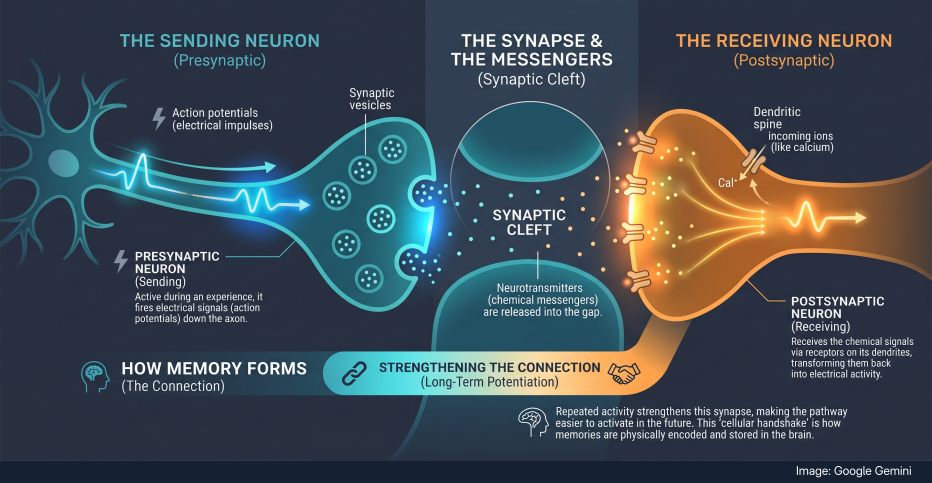
Mimicking the chemistry itself is a subject of study. Researchers build electrochemical transistors and memristors whose resistance changes with ion movement, which behaves like a synapse changing strength. However, these devices remain laboratory experiments and small-scale demonstrations only. Molecular storage is further along for a different job: DNA can hold information at theoretical densities of hundreds of petabytes per gram and lasts for centuries, but reading and writing take hours to days. That makes it an archive, comparable to tape, and it does not substitute for working memory. For now, the brain’s structure and algorithmic functioning inspires more usable ideas than its chemistry does.
Active Research, Open Questions
Researchers are working on every layer of this problem. The five lines of work below are under active development, and each has an open question attached.
- Cache compression
- Grouped-query attention, quantization of the key-value cache, and eviction of low-value tokens shrink the working memory a model needs. Which tokens are safe to drop remains hard to predict.
- Fixed-size state
- State-space models such as Mamba compress the whole history into a constant-size state, which lowers memory cost but loses some exact recall. Hybrids that mix these layers with attention are being tested.
- Better retrieval
- Context-aware chunking, hybrid keyword and vector search, reranking, and graph structures for relationship-heavy data all improve what comes back. Choosing the right structure for a given collection is still done mostly by hand.
- Managed memory
- Paging policies based on recency and access frequency decide what a long-running agent keeps close. Few shared benchmarks exist for judging whether an agent forgot correctly.
- Hardware
- Processing-in-memory and neuromorphic designs cut the distance between storage and arithmetic. Software tools and manufacturing lag behind the lab results.
Taken together, these efforts describe one design problem: a memory system that decides what to keep, how densely to store it, where to place it, and when to let it go. Today those decisions sit in separate layers built by separate teams; in model architecture, retrieval software, agent frameworks, and chip design. Computing faced the same split before operating systems and hardware memory hierarchies were designed together - an integration that made modern software possible.
An integrated memory system for AI is still a long way off. A model that carries years of a person's work, a patient's history, or a scientific field needs memory that stays compact as it grows, returns the right record in milliseconds, preserves the links between facts, and updates without retraining from scratch. Current systems manage some of these aspects, and each aspect is a complex research problem on its own. The human brain manages this feat while consuming the equivalent of a mere 20 watts of energy, demonstrating both the physical possibility and a sobering measure of how far away today's hardware sits. Progress will build incrementally layer by layer until the layers are able to work together. The systems that remember well will do the most useful work, and the long effort to build them is where the field's attention belongs.